

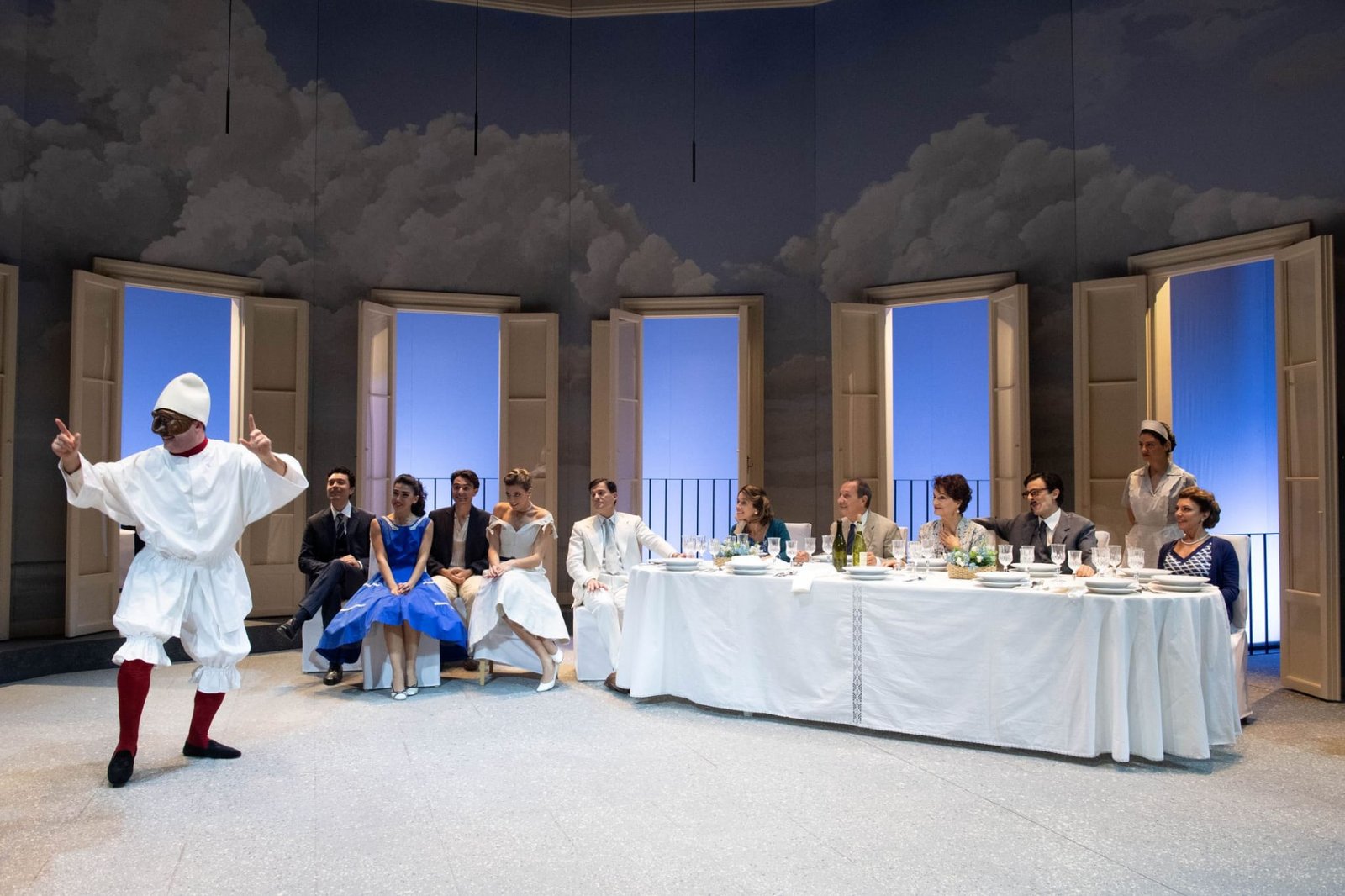
Among the most complex comedies d Eduardo de Filippo, the play debuted at the Teatro Argentina in Rome, thrilling audiences and critics alike. Luca De Fusco signs the direction of a show capable of speaking to the heart of all times, investigating family relationships and the breakability of human relationships, offering an unexpected solution of salvation. The most Chekhovian work of the Neapolitan genius will be on tour until the end of April.
By Rosalba Panzieri
The new staging of “Sabato, domenica e lunedì,” a comedy in three acts by Eduardo De Filippo, signed by Luca De Fusco brings back to the stage a text that, after an absence of more than 20 years, finds its natural temperature at Teatro Argentina: that of a comedy that pulses below the surface, where everyday life becomes dramaturgical matter and the family a laboratory of subtle tensions. De Fusco tackles Eduardo with an analytical, almost philological approach that does not stiffen but illuminates: the direction moves like a probe into the folds of the text, returning a domestic interior that vibrates with irony, conflict and tenderness.
The dramaturgy of the everyday
Sunday lunch becomes the beating heart of the play, a dramaturgical device that transforms the kitchen into an emotional combustion chamber. The slowly simmering ragout is no longer just a realistic detail, but represents an inner time, a hot breath punctuates the emergence of family cracks. In the culinary competition, in the imaginary jealousy, in the roles that weigh like crockery that has never been put away, a sentimental geography is drawn made up of minimal scraps, of silences that dilate, of words that brush against and wound. De Fusco grasps this fragile matter and arranges it on stage with almost choreographic precision, letting everyday life become ritual, letting the domestic gesture become revelation. Thus the Prior's house is transformed into a suspended place, where ordinary life opens up to a poetic dimension. The director draws a theater of intimacy in which every detail, becomes a signal of a balance that wavers and, precisely because of this, still concerns us. Inside a spoon that turns, a glance that deflects, a plate that waits, symbols of family and human relational dynamics emerge. This is why the work bursts into the present with the actuality of the customs and feelings it recounts. The family remains hiding place and revelation, role and identity, hiding place and salvation. But Eduardo with this work returns to tell us something more, he speaks of our need to belong even at the expense of our identity, of adhering to others' expectations in exchange for being loved. To reveal to us, in the moving confrontation between Rosa and Peppino, that love is the child of truth.
The history of the work
Written in 1959 and included in the “Cantata dei giorni dispari,” the play represents one of the most complex moments of Edwardian production. It is a work that is set in a rare, bourgeois, almost Chekhovian balance, built on a suspended time in which Sunday lunch becomes a detonator of fragility. Eduardo investigates there the family as a social microcosm, anticipating fractures that would become evident only decades later. Although belonging to a collection marked by a bitter view of existence, “Saturday, Sunday and Monday” surprises and moves with its luminous ending, almost a counterpoint to disillusionment. The family not only survives, but recomposes itself through authentic dialogue. The family does not endure, but is reborn, as Donna Rosa will say in the last line.
Precise and transparent direction to investigate reality
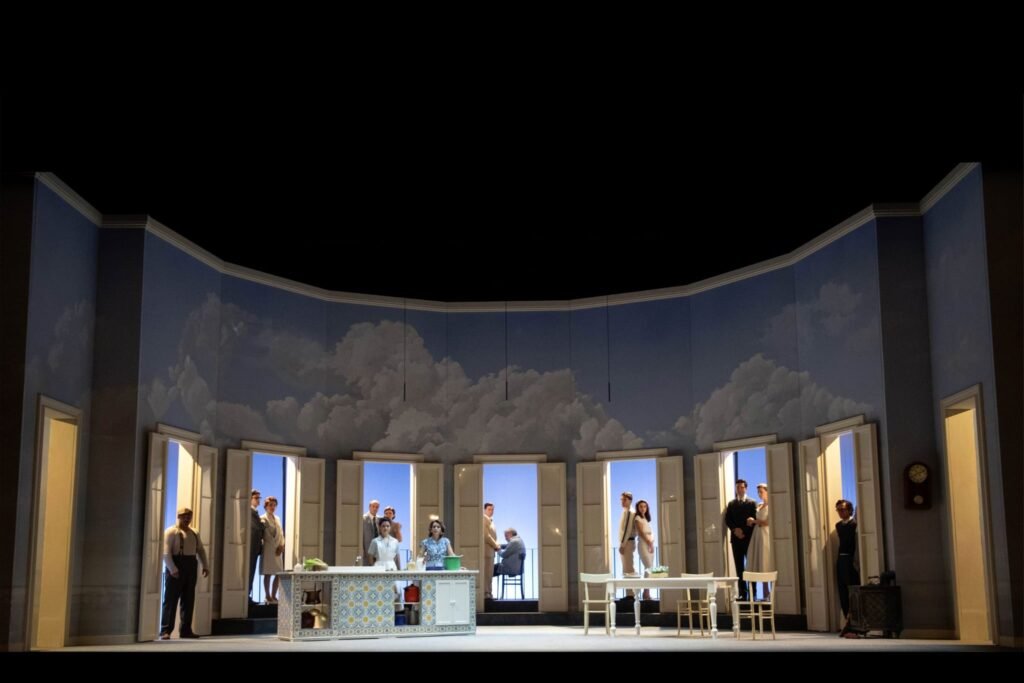
De Fusco chooses a direction of transparency, which does not overwrite but interprets. His is a “score-like” direction, which respects rhythm, pauses, internal dynamics of the text. Far from any temptation to rewrite, the director works by subtraction: he lets the Edwardian word expand, convinced that its strength lies in the surgical precision with which he observes human relationships. It is a countercultural gesture in a theater that often confuses disquiet with depth. Here, however, lightness becomes an instrument of truth, and the smile a gateway to complexity.
“The Piscopo family,“ says Luca De Fusco, ”is a true family, compact and attached to its rituals. It moves us because it knows how to heal its wounds and cares about the health of the group as a value. The women, as it should be, no longer prepare their husbands” shirts and socks and no longer devote hours and hours to the preparation of the mythical ragout. That family, however, stood on a balance, which we have not yet found. Rereading this masterpiece, we come to regret more the lost balance than the anticipation of future conflicts. And Eduardo's regret for a "normal" family, which he never had, emerges perhaps." Assistant director Lucia Rocco.
Great performances and impeccable actorly plot
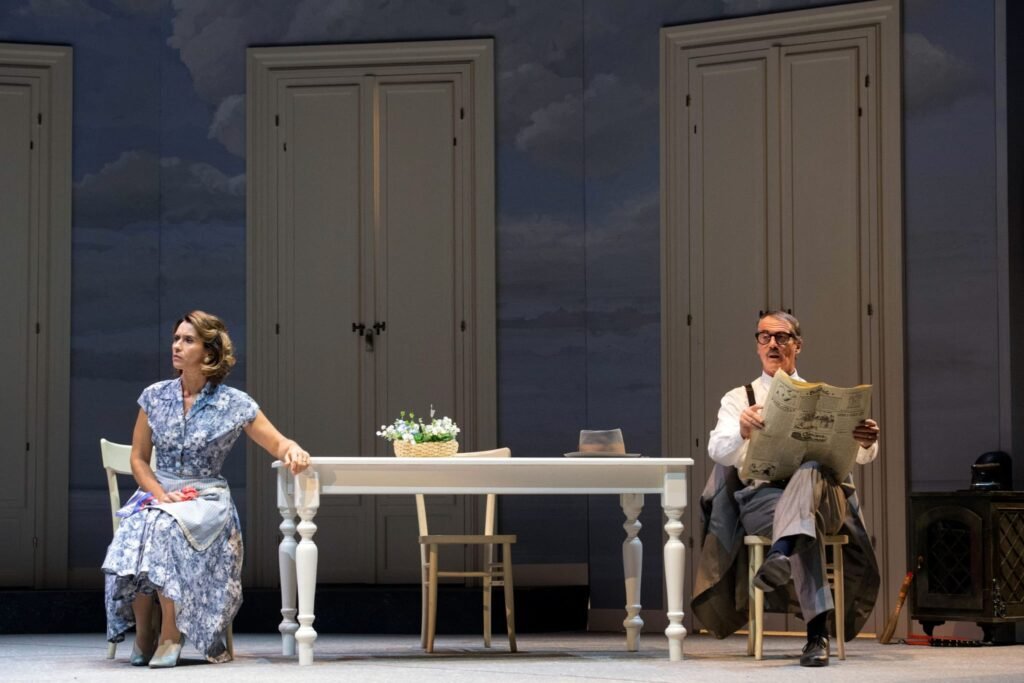
The company led by Teresa Saponangelo (Rosa Priore) and Claudio Di Palma (Peppino Priore) builds a compact ensemble at once capable of restoring the emotional density of the Priore family. Saponangelo gives life to a layered Rosa Priore, a female figure who absorbs tensions and governs chaos with quiet strength. Di Palma, as Peppino, embodies with admirable facets that imaginary jealousy that Eduardo sketches as a shadow more psychological than real. Around them, the Piscopo family, in which three generations are caught in a fragile balance, moves in a chorus that De Fusco orchestrates with musical rigor. Francesco Biscione (Antonio Piscopo, Rosa's father), gives us a performance of vibrant poetry as he shows the melancholies of a weary old man.
Scenes and costumes by Marta Crisolini Malatesta offer a rare immersive power, while lights by Gigi Saccomandi, create that score of shadow and light that perfectly coherently tells the dramaturgy's changes in tone.
A legacy that continues on national tour
The debut coincides with the 10th anniversary of Luca De Filippo's passing, adding a symbolic value to the staging that transcends the stage. It is a tribute that does not indulge in nostalgia, but reaffirms the vitality of an artistic legacy that continues to question our time. “Saturday, Sunday and Monday” thus confirms itself as a necessary comedy, a work that, between lightness and depth, restores the strength of a theater that is still alive, capable of illuminating our frailties with a grace that does not wear out. Produced by Teatro di Roma - Teatro Nazionale, Teatro Stabile di Torino - Teatro Nazionale, Teatro Stabile di Bolzano, Teatro Biondo di Palermo, LAC Lugano Arte e Cultura, the play will be on national tour until the end of April.
In Bolzano from Jan. 15 to 18, in Trent from Jan. 22 to 25, in Turin from Jan. 27 to Feb. 8, in Florence from Feb. 11 to 19, in Pontedera on Feb. 21 and 22, in Naples from March 3 to 8, in Ancona from March 11 to 15, in Palermo from March 21 to 29, in Ascoli Piceno on April 14 and 15, in Fermo from April 17 to 19, in Brescia from April 22 to 26.

 Italian
  Albanian
  English