


Rome's Teatro India was packed for the Muta Imago company's show, already acclaimed at the Romaeuropa Festival, which stems from the epistolary dialogue between philosopher Gunther Anders and pilot Claude Eatherly, who dropped the bomb on Hiroshima, nearly going mad with remorse. From Dec. 3 to 7 on stage in Turin
By Rosalba Panzieri
The National Theater puts on a civil-engagement hit with the Muta Imago company's latest show, which calls out and shocks audiences of all ages.
“Atomic” is first and foremost the story of two men, their relationship, the fragile and powerful tension that binds them; a cathartic friendship, to face together the destructive human action and the inevitable confrontation with one's conscience. It is a tale of how the memory of Hiroshima belongs not only to the past, but continues to interrogate the present, forcing us to face up to the responsibility of our technological and political choices.

The correspondence that becomes theater
The play grew out of an epistolary dialogue between Günther Anders and Claude Eatherly, the Straight Flush pilot who dropped the bomb on Hiroshima. Unable to free himself from the moral burden of that action, Eatherly plunges into a maelstrom of guilt, theft, suicide attempts and isolation, until he is admitted to the military psychiatric hospital in Waco. It was there, in 1959, that he received a letter from Anders, a philosopher committed to the analysis of man in relation to technology, former student of Heidegger and husband of Hannah Arendt. Claude gives himself unreservedly to that epistolary encounter, from which a profound dialogue about ethics, responsibility and the possibility of redemption takes shape. Together they will know how to unite visions and intentions to spread their message of peace and warning against the nuclear danger that has never escaped. Claude, who is hailed as a hero upon his return home, is the one overwhelmed, without making a secret of it, by the responsibility for 200,000 deaths. He hates himself, he deeply doubts his own conscience. Günther thus sees in him “the blameless culprit” that man becomes when he becomes a cog in a destructive system. This fate befalls the unknowing Claude, who becomes the symbol of a destructiveness that is impossible to bear and that causes him to live in a chaotic and self-defeating manner, and it will be the philosopher himself, in the first letter he writes to him, who will see in this sickness of living the sign of a consciousness that is still alive. “That, faced with this failure,” Anders writes, "His reaction is chaotic and disordered is therefore perfectly natural. Indeed, I dare say it is a sign of His moral health. For His reaction attests to the vitality of His conscience.".
A scenic landscape suspended between memory and the future
On stage, Gabriele Portoghese gives body to a tormented and elusive Claude, while Alessandro Berti embodies a lucid and visionary Anders. Both performances turn out masterful, capable of staging every emotional variation with both subtlety and strength. The action takes place in an abstract, mental space, suspended between before and after the deflagration, where memory and perception blur. In the background, an indefinable technological object, with vintage charm and futuristic foreboding, becomes a symbol of the reflection on the role of technology: a device that seems to anticipate the evolution to today's artificial intelligences and recalls the tragic light of the atomic explosion encapsulated in the Japanese word “pikadon,” lightning and roar. In this space of visual and aural fragments, the voices of Japanese survivors of the tragedy spread like an inner mantra, a chorus of conscience that spans time and still speaks today of all guilt and all wars. It is a chorus that haunts the ear of contemporary man, who always tries to escape through the daze of daily chaos. ’When we picked up those letters,“ Claudia Sorace and Riccardo Fazi recount, ”we realized that the world had changed: until recently, the atomic bomb seemed taboo, something to be talked about only with extreme caution. Today, however, it is discussed lightly, as if it had become an acceptable possibility. This mutation of language and perception is one of the engines of the show." With literary advice from Paolo Giordano, the show becomes, therefore, a theatrical journey that reflects on human power and limits, the fragility of human beings in the face of technology and the tension between destruction and catharsis.
Yesterday's bomb, today's weapons
Eighty years after Hiroshima, the world continues to live under the shadow of increasingly sophisticated and destructive arsenals. Contemporary nuclear, chemical, biological and now digital weapons have reached a power capable of annihilating entire populations in a matter of moments, making the threat no longer a memory of the past but a real possibility of the present. It is in this perspective that “Atomics” forces us to look at reality. Yesterday's bomb is not a closed chapter, but a warning that is renewed in the face of proliferation and the levity with which war and deterrence are discussed today. Only after recognizing this destructiveness does the play open up reflection on technology and the lesson unlearned by man. In the 1950s philosopher Günther Anders, along with Hannah Arendt and Martin Heidegger, had already denounced the risk of a technology capable of surpassing the man who created it. Today, in the age of artificial intelligence and algorithmic power, that thought returns urgently: the gap between our technological capacity and the moral responsibility it demands has become a crucial node. Atomica interrogates this very divide, tracing a thread that links the Hiroshima bomb to contemporary technologies, destruction to creation, blame to awareness.
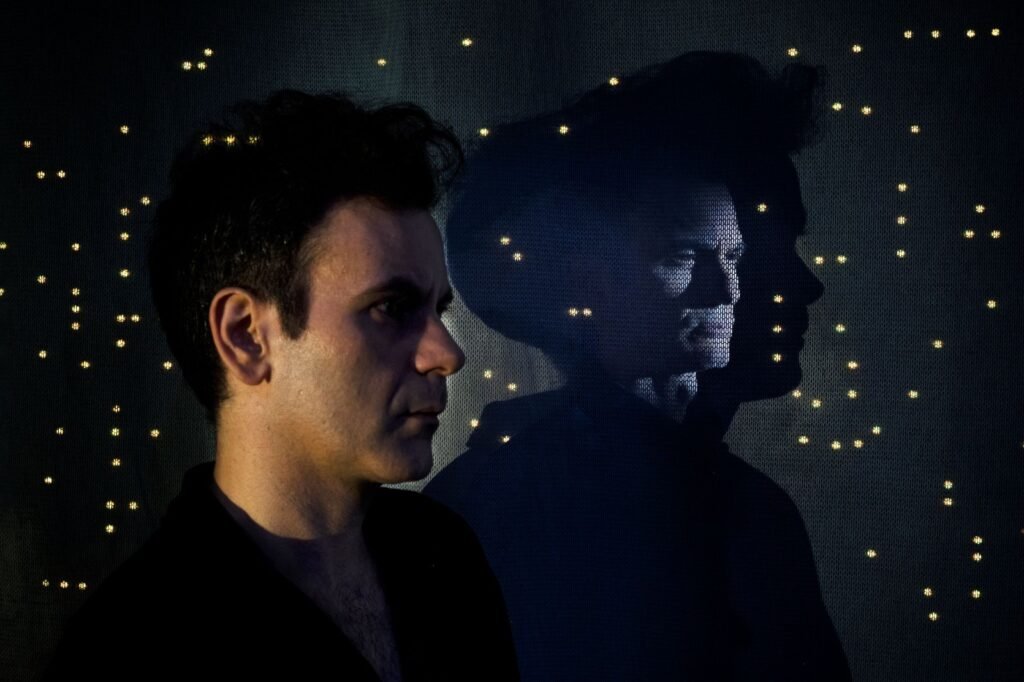
A theatrical journey on human frailty - tour dates
After the success of Three Sisters and the awards obtained with Ashes (Ubu Prize 2021 for best sound project and best lead actor), Muta Imago returns with “Atomica,” produced by Index and co-produced by TPE - Teatro Piemonte Europa, in collaboration with Politecnico di Torino - Prometeo Tech Cultures and Emilia Romagna Teatro ERT / Teatro Nazionale.
The show will be staged in Turin, TPE Teatro Astra, Dec. 3-7, and in Bologna, Arena del Sole, Jan. 16-17, 2026.
PHOTO BY ELEONORA MATTOZZI
 Italian
  Albanian
  English