

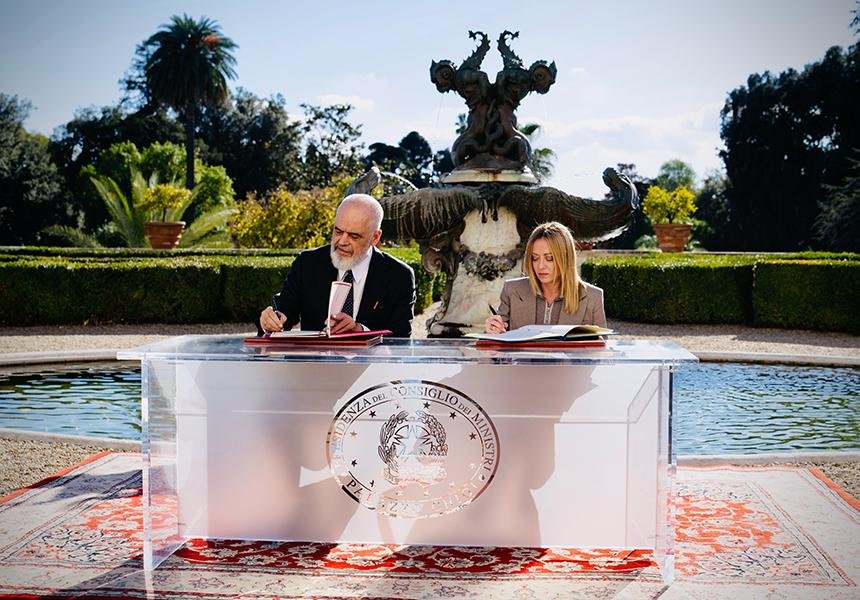
The intergovernmental summit between Rome and Tirana with the signing of 16 cooperation agreements and the announcement of a business forum in 2026 came at least 20 years too late. And not because of Albania , which since 1991 had thrown its doors wide open waiting for Italy, after the shames of fascism and war, to shake hands with a people battered by 47 years of dictatorship , longing for freedom and development.
Credit must be given to Edi Rama and Giorgio Meloni for closing an unexciting page of history in the relations between the two countries and opening a new one that can, at last, foreshadow structured and not occasional cooperation such as there has been so far.
It is true that some 3,000 Italian companies operate in Albania; it is true that Rome is Tirana's leading trading partner. It is true that there has long been cooperation between our police forces and those in Albania. But all this is not enough.
Italian governments have so far failed to develop an organic vision of relations with a neighboring country not only geographically but also and especially culturally and economically.
Italy wasted an enormous heritage, which was its linguistic heritage. In Albania almost everyone had learned Italian during the dictatorship and many had learned or perfected it during the years spent by thousands of families in Italy. Today in Albania the younger generation does not speak our language, perhaps they understand a few words from having heard it in the past from grandparents and parents. To have a people who speak our language just a stone's throw from our shores and not to value this heritage was a waste and also an insult to the Albanians who had learned our language on the sly and risked going to jail and then saw the usefulness of this learning almost disappear.
The revival of Italian culture has restarted in recent years with the intense activity of the Italian Cultural Institute led with wisdom and commitment by Alessandro Ruggera. And this, too, is a sign of a turning point.
Economically, there has been no coordinated Italian industrial policy, companies have landed on the other side of the Adriatic without a common strategic vision .
Yet Albania , because of its geographic proximity, tax advantages, low cost of living and labor, considerable agricultural and natural resources especially in the water and energy fields would have been the ideal place for investment in so many industries. It is never too late, although in the meantime other countries have invested in Albania, occupying spaces that Italy has missed.
But now there is a change. Finally. And it is moving beyond the controversy over the Shengjin and Giadër migrant centers, centers that were built two years ahead of the entry into force of European standards that from next June will allow them to function properly, as we have written several times on Albanitaly
Albania has always been European and Western will officially be so in the next 5 years also with the strong support of Italy. Now we need to roll up our sleeves .Italy must do everything to be Albania's No. 1 reference point and do everything for Tirana to become the most influential reference point in the Western Balkans.
It is deserved by all Albanian citizens who resisted with immense suffering the communist dictatorship and who looked with confidence to Italy as a free, democratic, and socially prosperous big sister

 Italian
  Albanian
  English