

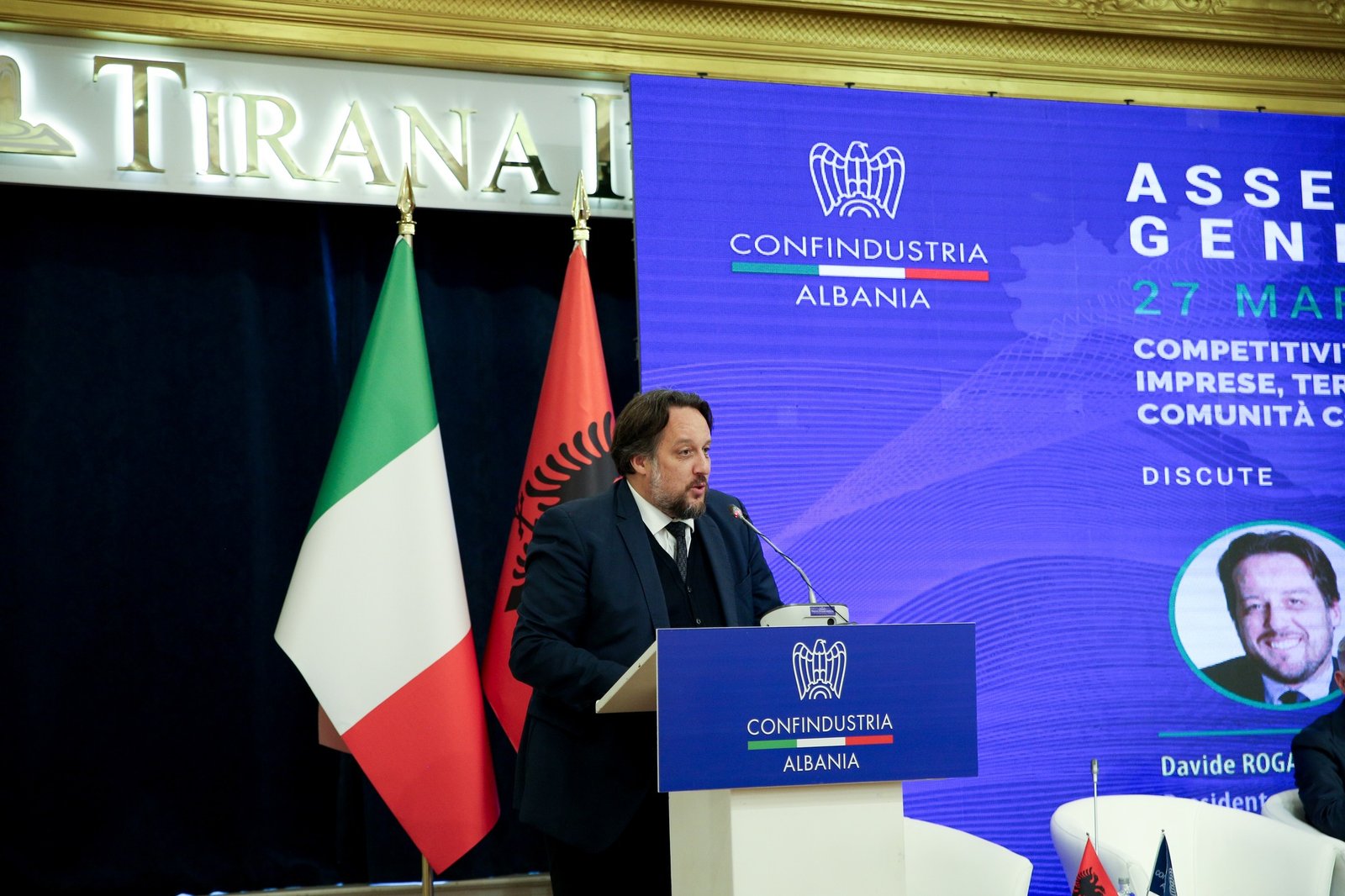
You have been President of Confindustria Albania for a year. But you have been in Albania for a while.
Yes, for 11 years
Why did you choose to come to Albania?
In 2014, we were looking for a solution to internationalize our IT company. We had tried before with a partner in Romania. It went very badly, and so, after the disappointment of that attempt, thanks to funding for internationalization from my region, Tuscany, we started a training project in Albania with another partner. There was definitely an interesting labor cost, and at that time (though less so today), there was a welcoming attitude and a closeness, especially linguistically, which obviously encouraged us to attempt an investment in that country..
So he's not sorry
No, absolutely. After 11 years, I continue to be a big sponsor of the Albanian opportunity. And I like to talk about it, trying to eliminate stereotypes about Albania that are based solely on low labor costs. There are many talents here. what makes this emerging country a place of great opportunities, to be managed with great care and not with recklessness. It is not an easy business, but it is nevertheless solid.
How many Italian companies are there in Albania and how many of them are registered with Confindustria?
The number of companies is a mystery because, in any case, cross-referencing data in a country like this is not very easy. With the embassy, we are working to conduct a census to clarify the fantasy numbers that have been circulated. There was talk of about 3,000 companies, but we know that many are just VAT numbers, not strictly companies. There are about 700 real companies, with majority Italian capital. In Confindustria Albania, there are 170 associated companies. We don't just have companies with Italian capital, although those with majority Italian capital represent 85%% of our members.
Are there many joint ventures?
Italian joint ventures in Albania represent a fundamental pillar of economic cooperation between the two countries, especially in the industrial, energy, and manufacturing sectors. A successful example is Coca-Cola Bottling Shqipëria (CCBS), an international joint venture with Italian capital, which demonstrates stable and strategic investment in the country. Furthermore, the fact that the Vice President of Confindustria Albania comes from this company highlights its central role in the Italian-Albanian business community.
What are the sectors with the highest representation?
There have been various phases. In past years, there was a lot of use of intermediate processing in some manufacturing industries, particularly in the fashion and apparel sector but also in mechanics. Now, service activities are increasingly favored, starting with call centers and customer care, but also in my sector, ICT.
In the IT sector, is there a generation of very skilled young Albanians?
One of the great values of this country is English language proficiency. Much improvement can be made to university education. From a technological standpoint, there are interactions where Italy lags behind the United States and other economies, primarily Northern European ones. In general, Albania would need a strong commitment from Italian companies for training, but there is some resistance from Albanian authorities. To be honest, there is also the usual habit that leads some entrepreneurs to try to go it alone. This, of course, leads to problems both in terms of the economic balance of projects and their sustainability, but sometimes also in interactions with institutions. There is a lack of strategic coordination of various initiatives.
In November 2025, an intergovernmental summit.
Was there an initiative in February already?
It was about Corridor 8. Which is another of the historical themes, it concerns logistics and, more generally, the connection of the Western Balkans. Now a system mission is needed. This year, our main task will be to work with the embassy to choose which sectors to represent best and which events to organize. We are ready and waiting for the signal to start.
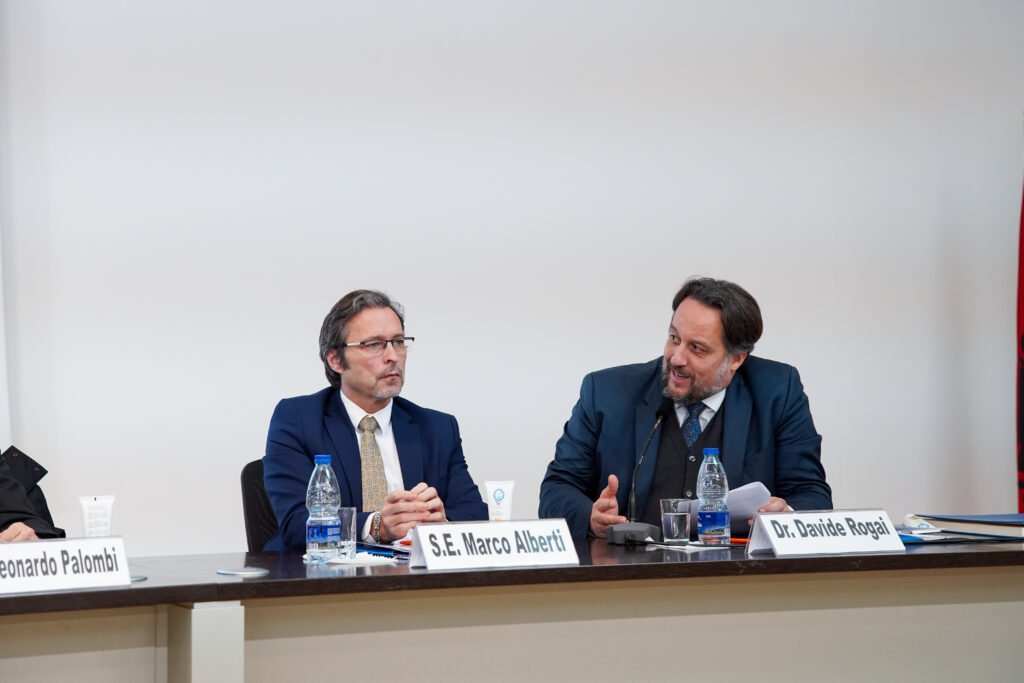
Is there a center that coordinates the interventions planned by the 12 protocols?
No. The common thread is the geopolitical importance of Albania for Italy and of Italy for Albania. Therefore, the agreement was made because it is important for Italy to have a presence in this geographic area. In turn, Albania counts heavily on dialogue with Italy for its entry into the European Union.
How does cooperation between Confindustria Albania and the Chamber of Commerce work?
Cooperation between Confindustria Albania and the Italian-Albanian Chamber of Commerce is close and is based on shared initiatives to support businesses. There is also important continuity at the institutional level: the President of the Italian-Albanian Chamber of Commerce, Cristina Busi, is also Vice President of Confindustria Albania.
As Confindustria Internazionale, we work in strong synergy with the Italian Embassy and institutions like ICE, which contribute to coordinating and promoting the Italian system in the country.
Our approach always starts with listening to the concrete needs of our members, in order to develop targeted and effective activities. In general, we are talking about a highly integrated ecosystem, in which institutions and associations collaborate to further strengthen economic relations between Italy and Albania.
What are the most interesting development prospects for Albania in which Italy can become involved?.
In my opinion, there's an energy theme that is fundamental.
Regarding this, I've always wondered why Italian industries don't take advantage of the very low energy costs here in Albania.
The theme is the balance between context and skills. So let's return to the topic of training. In my opinion, the real issue is the workforce, understood as the quantity of people needed and the geographical distribution of employees. Albania is too concentrated on the capital, as happens in all emerging countries. One of our goals is to try to distribute activities and the workforce to other developing territories as well. Beyond the number of workers, there is the problem of the level of training and their skills. Companies encounter many difficulties. For our associates, we have created a portal exclusively for job postings.
Is there a labor shortage?
Shortage of technical and qualified personnel, shortage of managers, and difficulty in finding them.
In Albania, young people are leaving for other European countries, no longer mainly for Italy, as was the case until a few years ago.,
Are there no management schools here?
No, this is one of the big problems. Universities are proliferating, and many of them also organize postgraduate courses. Many are in English. What's missing is a higher education institution, a business school with an Italian imprint.
Could Luiss think about it?
Why not. Anyway, Confindustria Albania, together with its associates, has a wealth of knowledge and experience to begin training managers. However, this is a strategic investment that requires the involvement of the entire Italian system.
Would the Albanian government view positively an Italian commitment to train the new leading class?
Certainly. Moreover, Italy, unlike other countries, does not train people and then bring them back to their home country. We train people and leave them in their home country.
I think the Albanian government considers Italy a supportive partner, rather than a predator of valuable people.
It is important to us that the Government recognizes the value of those who invest in training new talent in Albania, even at a private level.
Tools like subsidized training or tax credits can be a strong incentive. In general, policies that provide tax benefits are needed to concretely support these investments.
In the tourism sector, on which the Albanian government is focusing heavily, there is a significant shortage of training, which clashes with the architectural beauty of many structures.
I agree. We can provide a lot of support in this area, also drawing on the experiences of many of our members in various tourism-related activities.
And in facility management, which is essential, especially for the futuristic constructions being realized in Tirana, Durrës, Vlorë, and Shkodër, can we make a contribution?
This could be another area to focus on.
Will trade and business activities improve with Albania's entry into Europe in 4-5 years?
There are two points. The first is customs. One of the first commitments as Confindustria Albania was precisely to reach agreements with customs to simplify procedures.
There are cases like free zones where customs is actually moved closer to the production site; there are public areas, for example, one in Elbasan and one in Durrë, where conditions are being improved for introducing and exporting goods. With entry into Europe, this issue will be overcome, and both trade and the possibility of using more modern machinery to be moved to these areas will be greatly facilitated. In the meantime, Albania is preparing by appreciating its currency, the Lek.
Naturally, interventions on regulations will then be necessary, I'm thinking about those on privacy, on labor law, and this will lead to a decrease in the advantage that is significant today due to the cost difference between Italy and Albania. However, the integration of skills will certainly be very interesting..
Could Albania, due to its dynamism, be considered a kind of hub for the entire Western Balkans region?
For Italy, this is the right vision, because Albania is the closest country to us in the Balkans, not only geographically but also culturally and in NATO's perspective. For us, it's the gateway to the Western Balkans. Naturally, rivalries can exist between the various countries in this area. It could happen that something coming from Albania is not well-received in some other country, and vice versa. However, in the economic sphere, these jealousies are easily overcome.
Will the new Port of Durrës be an important infrastructure?
This is a strategic element to give a central role to central Albania. It is one of the themes of Corridor 8.
In the construction sector, which has been strong for a long time, there are not many Italian investments.
There are service providers, engineering firms, and architecture firms. It doesn't seem like there are any large construction companies.
Which countries are our main competitors in Albania?
In the landscape of foreign investments in Albania, Italy represents one of the main partners, with a very widespread and rooted presence, especially in industrial and manufacturing sectors. Alongside Italy, Turkey is today among the top investors by volume, with a significant share of direct investments.
Countries like the Netherlands and Austria also play an important role, particularly in terms of the overall stock of investments. Overall, this is therefore a strongly European picture, in which Italy continues to play a central role.
Let's get back to energy for a moment. Albania has the largest natural hydrogen deposit in the world. Italy is making some moves regarding hydrogen. Are there any ideas in this area?
Regarding hydrogen, Albania has become very interesting after the recent discovery of a significant natural hydrogen deposit. It is still under study, but it could have strong strategic potential. In reality, we are still working here to better exploit the hydroelectric generation potential. There is abundant water, and the utilization of hydroelectric energy is still low.
Albania is heavily focused on renewables. And that's interesting. However, energy involves government agreements. Investments are heavily driven by the country's business climate. This includes legal certainty, the power and quality of interference from local authorities. What interests us is that the investment can be made smoothly to reduce risks.
What is the goal you have publicly and secretly set for your term as head of Confindustria?
Publicly, the goal is to grow the number of members and strengthen Confindustria's presence in Albania.
More deeply, however, the commitment is to bring more and more Italian companies closer to the country, because it is precisely through this presence that Confindustria's role is strengthened and its ability to work concretely in favor of Italian business in Albania.
Secretly continue to convince all my personal and business contacts to overcome skepticism towards Albania and believe in the development of this country which is, on a small scale, a kind of Italy of some years ago when people put all their effort into making it and ensuring a better tomorrow for themselves and future generations.
 Italian
  Albanian
  English